INSIDE EVERY REP Free plan

Film · Inside the Squat · 10:39

What Squats Really Do for Your Body

Coming soon. Until then, find us on YouTube at @insideeveryrep.

What the film covers

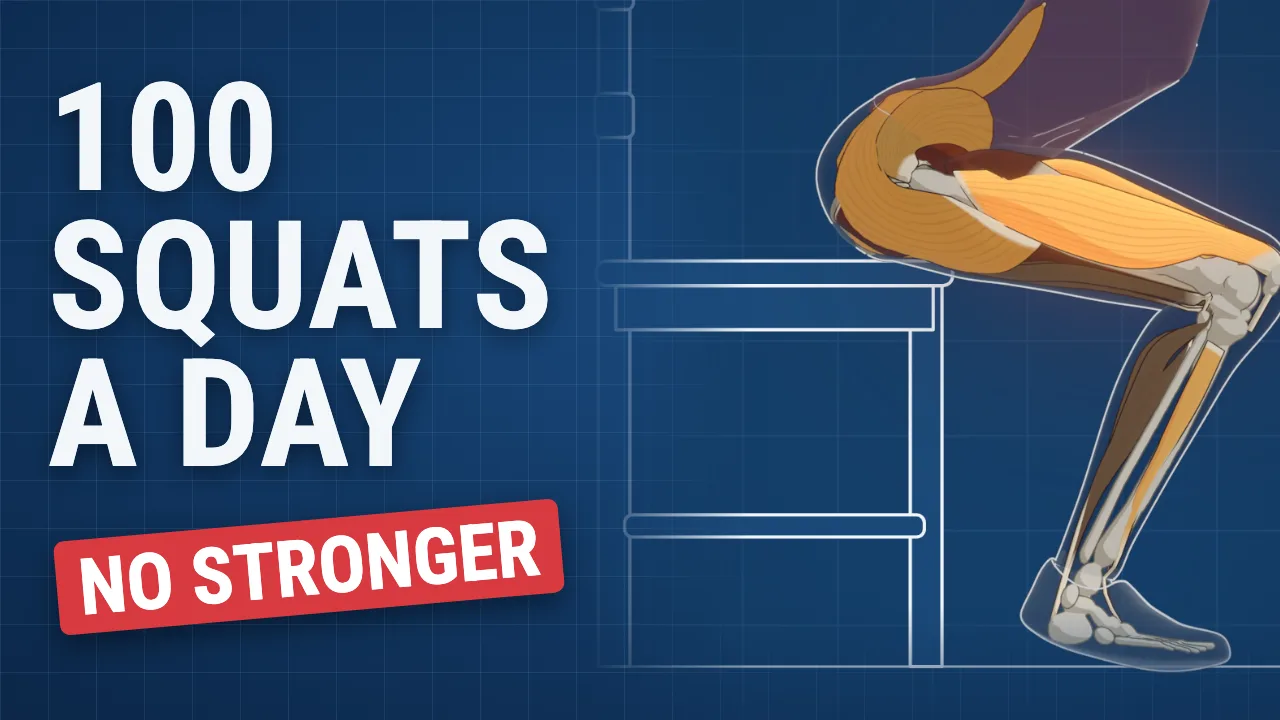
In one small study, older adults did a hundred squats a day for four months and got no stronger. In another, people aged seventy or more did far fewer, and their thigh muscle grew more than in a group who carried on as usual. This film shows which muscles a squat works, what happens inside a muscle from today to ten weeks from now, and what the research says made the difference.

Then what you gain if you keep at it: in small studies, when bodyweight squats got a little harder over time, legs got stronger, and the thigh muscle a little thicker, within six to twelve weeks; in strength-training trials in older people, they got up from a chair more quickly. And your plan: one set of eight to twelve, two days a week, to start, then build up.

Chapters

  1. 0:00 100 squats a day, and no stronger?
  2. 0:47 Do it right
  3. 2:17 Inside your muscles
  4. 2:50 Four together
  5. 4:03 Inside the muscle: today to week 10
  6. 6:47 What you gain
  7. 7:52 Your plan
  8. 9:54 Your turn

Safety

General education, not medical advice.

Ask your own doctor first if you have: a heart condition · high blood pressure, even if controlled · diabetes · a pacemaker or defibrillator · a past stroke · a joint replacement · a bone, joint or muscle problem · a pregnancy · a fall in the past twelve months, or unsteadiness · any other medical condition.

Very high blood pressure that is not under control, or a heart condition that is not stable: not now. See your doctor.

Use a solid chair with no wheels, one that will not slip, with its back against a wall. Keep something sturdy within reach. Clear the floor, and wear shoes that grip.

If anything hurts, stop. If you feel dizzy, light-headed or unwell, or your heart is racing, or you are unusually out of breath, sit down on your chair straight away, and stop for today. Speak to a doctor before you exercise again. And for chest pain, real trouble breathing, or fainting, call your emergency number. (999 UK · 911 US · 112 EU)

In daily life: Stand up slowly, with a hand near something solid. If you ever feel light-headed when you stand, tell your doctor.

Sources

  1. Hirono T, Kunugi S, Yoshimura A, Ueda S, Goto R, Akatsu H, et al. Effects of home-based bodyweight squat training on neuromuscular properties in community-dwelling older adults. Aging Clin Exp Res. 2023;35(5):1043-1053. https://pubmed.ncbi.nlm.nih.gov/36853505/
  2. Tsuzuku S, Kajioka T, Sakakibara H, Shimaoka K. Slow movement resistance training using body weight improves muscle mass in the elderly: A randomized controlled trial. Scand J Med Sci Sports. 2018;28(4):1339-1344. https://pubmed.ncbi.nlm.nih.gov/29247985/
  3. Isear JA Jr, Erickson JC, Worrell TW. EMG analysis of lower extremity muscle recruitment patterns during an unloaded squat. Med Sci Sports Exerc. 1997;29(4):532-9. https://pubmed.ncbi.nlm.nih.gov/9107637/
  4. Wackerhage H, Schoenfeld BJ, Hamilton DL, Lehti M, Hulmi JJ. Stimuli and sensors that initiate skeletal muscle hypertrophy following resistance exercise. J Appl Physiol. 2019;126(1):30-43. https://pubmed.ncbi.nlm.nih.gov/30335577/
  5. MacDougall JD, Gibala MJ, Tarnopolsky MA, MacDonald JR, Interisano SA, Yarasheski KE. The time course for elevated muscle protein synthesis following heavy resistance exercise. Can J Appl Physiol. 1995;20(4):480-6. https://pubmed.ncbi.nlm.nih.gov/8563679/
  6. Phillips SM, Tipton KD, Aarsland A, Wolf SE, Wolfe RR. Mixed muscle protein synthesis and breakdown after resistance exercise in humans. Am J Physiol. 1997;273(1 Pt 1):E99-107. https://pubmed.ncbi.nlm.nih.gov/9252485/
  7. Moritani T, deVries HA. Neural factors versus hypertrophy in the time course of muscle strength gain. Am J Phys Med. 1979;58(3):115-30. https://pubmed.ncbi.nlm.nih.gov/453338/
  8. Munn J, Herbert RD, Gandevia SC. Contralateral effects of unilateral resistance training: a meta-analysis. J Appl Physiol. 2004;96(5):1861-6. https://pubmed.ncbi.nlm.nih.gov/15075311/
  9. Manca A, Dragone D, Dvir Z, Deriu F. Cross-education of muscular strength following unilateral resistance training: a meta-analysis. Eur J Appl Physiol. 2017;117(11):2335-2354. https://pubmed.ncbi.nlm.nih.gov/28936703/
  10. DeFreitas JM, Beck TW, Stock MS, Dillon MA, Kasishke PR 2nd. An examination of the time course of training-induced skeletal muscle hypertrophy. Eur J Appl Physiol. 2011;111(11):2785-90. https://pubmed.ncbi.nlm.nih.gov/21409401/
  11. Damas F, Phillips SM, Lixandrão ME, Vechin FC, Libardi CA, Roschel H, et al. Early resistance training-induced increases in muscle cross-sectional area are concomitant with edema-induced muscle swelling. Eur J Appl Physiol. 2016;116(1):49-56. https://pubmed.ncbi.nlm.nih.gov/26280652/
  12. Damas F, Phillips SM, Libardi CA, Vechin FC, Lixandrão ME, Jannig PR, et al. Resistance training-induced changes in integrated myofibrillar protein synthesis are related to hypertrophy only after attenuation of muscle damage. J Physiol. 2016;594(18):5209-22. https://pubmed.ncbi.nlm.nih.gov/27219125/
  13. Damas F, Libardi CA, Ugrinowitsch C. The development of skeletal muscle hypertrophy through resistance training: the role of muscle damage and muscle protein synthesis. Eur J Appl Physiol. 2018;118(3):485-500. https://pubmed.ncbi.nlm.nih.gov/29282529/
  14. Mitchell WK, Williams J, Atherton P, Larvin M, Lund J, Narici M. Sarcopenia, dynapenia, and the impact of advancing age on human skeletal muscle size and strength; a quantitative review. Front Physiol. 2012;3:260. https://pubmed.ncbi.nlm.nih.gov/22934016/
  15. Nilwik R, Snijders T, Leenders M, Groen BB, van Kranenburg J, Verdijk LB, et al. The decline in skeletal muscle mass with aging is mainly attributed to a reduction in type II muscle fiber size. Exp Gerontol. 2013;48(5):492-8. https://pubmed.ncbi.nlm.nih.gov/23425621/
  16. Leenders M, Verdijk LB, van der Hoeven L, van Kranenburg J, Nilwik R, van Loon LJ. Elderly men and women benefit equally from prolonged resistance-type exercise training. J Gerontol A Biol Sci Med Sci. 2013;68(7):769-79. https://pubmed.ncbi.nlm.nih.gov/23223011/
  17. Borde R, Hortobágyi T, Granacher U. Dose-Response Relationships of Resistance Training in Healthy Old Adults: A Systematic Review and Meta-Analysis. Sports Med. 2015;45(12):1693-720. https://pubmed.ncbi.nlm.nih.gov/26420238/
  18. Schoenfeld BJ, Grgic J, Ogborn D, Krieger JW. Strength and Hypertrophy Adaptations Between Low- vs. High-Load Resistance Training: A Systematic Review and Meta-analysis. J Strength Cond Res. 2017;31(12):3508-3523. https://pubmed.ncbi.nlm.nih.gov/28834797/
  19. Currier BS, D'Souza AC, Singh MAF, Lowisz CV, Rawson ES, Schoenfeld BJ, et al. American College of Sports Medicine Position Stand. Resistance Training Prescription for Muscle Function, Hypertrophy, and Physical Performance in Healthy Adults: An Overview of Reviews. Med Sci Sports Exerc. 2026;58(4):851-872. https://pmc.ncbi.nlm.nih.gov/articles/PMC12965823/
  20. Liu CJ, Latham NK. Progressive resistance strength training for improving physical function in older adults. Cochrane Database Syst Rev. 2009;2009(3):CD002759. https://pubmed.ncbi.nlm.nih.gov/19588334/
  21. Momma H, Kawakami R, Honda T, Sawada SS. Muscle-strengthening activities are associated with lower risk and mortality in major non-communicable diseases: a systematic review and meta-analysis of cohort studies. Br J Sports Med. 2022;56(13):755-763. https://pubmed.ncbi.nlm.nih.gov/35228201/
  22. Sherrington C, Fairhall NJ, Wallbank GK, Tiedemann A, Michaleff ZA, Howard K, et al. Exercise for preventing falls in older people living in the community. Cochrane Database Syst Rev. 2019;1(1):CD012424. https://pubmed.ncbi.nlm.nih.gov/30703272/
  23. Bull FC, Al-Ansari SS, Biddle S, Borodulin K, Buman MP, Cardon G, et al. World Health Organization 2020 guidelines on physical activity and sedentary behaviour. Br J Sports Med. 2020;54(24):1451-1462. https://pmc.ncbi.nlm.nih.gov/articles/PMC7719906/
  24. American College of Sports Medicine. American College of Sports Medicine position stand. Progression models in resistance training for healthy adults. Med Sci Sports Exerc. 2009;41(3):687-708. https://pubmed.ncbi.nlm.nih.gov/19204579/
  25. Paluch AE, Boyer WR, Franklin BA, Laddu D, Lobelo F, Lee DC, et al. Resistance Exercise Training in Individuals With and Without Cardiovascular Disease: 2023 Update: A Scientific Statement From the American Heart Association. Circulation. 2024;149(3):e217-e231. https://pmc.ncbi.nlm.nih.gov/articles/PMC11209834/
  26. Hody S, Croisier JL, Bury T, Rogister B, Leprince P. Eccentric Muscle Contractions: Risks and Benefits. Front Physiol. 2019;10:536. https://pmc.ncbi.nlm.nih.gov/articles/PMC6510035/
  27. Cheung K, Hume P, Maxwell L. Delayed onset muscle soreness : treatment strategies and performance factors. Sports Med. 2003;33(2):145-64. https://pubmed.ncbi.nlm.nih.gov/12617692/
  28. Royal Osteoporosis Society. How to exercise safely for bones. Last reviewed 1 June 2026. https://theros.org.uk/information-and-support/exercise/how-to-exercise-safely-for-bones/
  29. Flann KL, LaStayo PC, McClain DA, Hazel M, Lindstedt SL. Muscle damage and muscle remodeling: no pain, no gain? J Exp Biol. 2011;214(Pt 4):674-9. https://pubmed.ncbi.nlm.nih.gov/21270317/
  30. Hortobágyi T, Mizelle C, Beam S, DeVita P. Old adults perform activities of daily living near their maximal capabilities. J Gerontol A Biol Sci Med Sci. 2003;58(5):M453-60. https://pubmed.ncbi.nlm.nih.gov/12730256/
  31. Nishiwaki GA, Urabe Y, Tanaka K. EMG Analysis of Lower Extremity Muscles in Three Different Squat Exercises. J Jpn Phys Ther Assoc. 2006;9(1):21-6. https://pubmed.ncbi.nlm.nih.gov/25792947/
  32. Kitamura T, Kido A, Ishida Y, Kobayashi Y, Tsukamoto S, Tanaka Y. Muscle Activity Pattern with A Shifted Center of Pressure during the Squat Exercise. J Sports Sci Med. 2019;18(2):248-252. https://pubmed.ncbi.nlm.nih.gov/31191094/
  33. Lee TS, Song MY, Kwon YJ. Activation of back and lower limb muscles during squat exercises with different trunk flexion. J Phys Ther Sci. 2016;28(12):3407-3410. https://pubmed.ncbi.nlm.nih.gov/28174462/
  34. Lubahn AJ, Kernozek TW, Tyson TL, Merkitch KW, Reutemann P, Chestnut JM. Hip muscle activation and knee frontal plane motion during weight bearing therapeutic exercises. Int J Sports Phys Ther. 2011;6(2):92-103. https://pubmed.ncbi.nlm.nih.gov/21713231/
  35. Dionisio VC, Almeida GL, Duarte M, Hirata RP. Kinematic, kinetic and EMG patterns during downward squatting. J Electromyogr Kinesiol. 2008;18(1):134-43. https://pubmed.ncbi.nlm.nih.gov/17029862/
  36. Macadam P, Feser EH. Examination of gluteus maximus electromyographic excitation associated with dynamic hip extension during body weight exercise: a systematic review. Int J Sports Phys Ther. 2019;14(1):14-31. https://pubmed.ncbi.nlm.nih.gov/30746289/
  37. Krieger JW. Single versus multiple sets of resistance exercise: a meta-regression. J Strength Cond Res. 2009;23(6):1890-901. https://pubmed.ncbi.nlm.nih.gov/19661829/
  38. U.S. Department of Health and Human Services. Physical Activity Guidelines for Americans, 2nd edition. Washington, DC: U.S. Department of Health and Human Services; 2018. https://odphp.health.gov/sites/default/files/2019-09/Physical_Activity_Guidelines_2nd_edition.pdf
  39. Centers for Disease Control and Prevention, National Center for Injury Prevention and Control. STEADI (Stopping Elderly Accidents, Deaths & Injuries): Chair Rise Exercise. 2017. https://www.cdc.gov/steadi/pdf/steadi-brochure-chairriseex-508.pdf
  40. Wei W, Zhu J, Ren S, Jan YK, Zhang W, Su R, et al. Effects of progressive body-weight versus barbell back squat training on strength, hypertrophy and body fat among sedentary young women. Sci Rep. 2023;13(1):13505. https://pubmed.ncbi.nlm.nih.gov/37598268/
  41. Lizama-Pérez R, Chirosa-Ríos LJ, Contreras-Díaz G, Jerez-Mayorga D, Jiménez-Lupión D, Chirosa-Ríos IJ. Effect of sit-to-stand-based training on muscle quality in sedentary adults: a randomized controlled trial. PeerJ. 2023;11:e15665. https://pubmed.ncbi.nlm.nih.gov/37456889/
  42. Yoshiko A, Watanabe K. Impact of home-based squat training with two-depths on lower limb muscle parameters and physical functional tests in older adults. Sci Rep. 2021;11(1):6855. https://pubmed.ncbi.nlm.nih.gov/33767255/
  43. Hummelmann S, Kramer M, Laufs U, Fikenzer S, Lässing J, Falz R. Breathing technique-dependent acute cardiopulmonary responses during squats in healthy females. Physiol Rep. 2026;14(6):e70831. https://pubmed.ncbi.nlm.nih.gov/41857805/
  44. Heidelbach MJ, Lange S, Edelhäuser F, Cysarz D. Sit-to-stand and stand-to-sit transitions stimulate cardiac autonomic regulation and lead to age-dependent short-term patterns in heart rate. Front Physiol. 2026;17:1733672. https://pubmed.ncbi.nlm.nih.gov/41907536/

Found a mistake, or a better study? Tell us in the comments under the film, or use our contact form.

Read the transcript

100 squats a day, and no stronger?

A hundred squats a day, every day, for four months. In one small study, older adults of about seventy-eight did exactly that. They got no stronger. In another, people aged seventy or more began with two sets of ten slow squats, plus a few other moves, adding a couple more every four weeks. After twelve weeks, their thigh muscle and strength had grown more

than in a group who carried on as usual. So what made the difference? Stay with me. We'll see which muscles a squat works, what happens inside them, and how to make your own squats count.

First: this is general fitness education, not medical advice.

Do it right

Ask your own doctor before you join in if you have a heart condition; high blood pressure, even if it is controlled; diabetes; a pacemaker; a past stroke; a joint replacement, or a bone or joint problem, sore knees included; if you are pregnant; or if you have had a fall in the past twelve months, or feel unsteady.

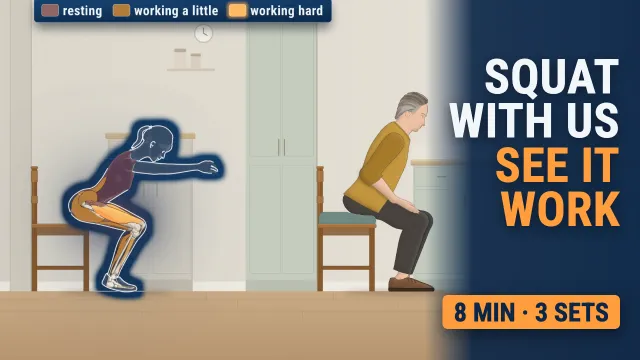
For now, just watch. Use a solid chair with no wheels, one that will not slip, with its back against a wall. Keep something sturdy within reach. Clear the floor, and wear shoes that grip. This week's move is the chair squat. Feet about shoulder width, flat on the floor.

Sit back and down, slowly, until you just touch the seat. Then push the floor away. Breathe out as you stand, in as you sit. Never hold your breath. From the front, your knees point the same way as your toes.

Our neighbour starts gentler: a firm cushion that will not slide, hands on the thighs, and sitting right down before standing.

For older people, just getting up from a chair is real work: in a small study of healthy people in their seventies, it took about eighty percent of their knee strength.

Inside your muscles

So which muscles do the work?

In one study of forty-one adults squatting with no weight, the front of the thigh worked at up to about two-thirds of its full effort. The hamstrings, at the back of the thigh, barely worked. Other small studies, mostly of young adults, found your buttock, the side of your hip and your lower back working too, but much less.

Your calves work lightly, and the front of your shin helps you start down.

Four together

If anything hurts, stop. If you feel dizzy, light-headed or unwell, or your heart is racing, or you are unusually out of breath, sit down on your chair straight away, and stop for today. Speak to a doctor before you exercise again. And for chest pain,

real trouble breathing, or fainting, call your emergency number. Now, four together. If you are on that list, just watch. Back and down, slowly. Touch. And push the floor away. One.

Two.

Breathe out as you rise. Three. Last one.

Four. While you squat, your heart beats faster, within seconds of the first rep. That's normal. A racing or pounding heart is not: that's a stop sign. Keep that chair where it is. We'll use it again. Keep those two studies in mind. We're coming back to them.

Inside the muscle: today to week 10

What happens inside that muscle, from today to ten weeks from now? These timings come from studies of younger adults. Today, as you lower, the fibres are pulled under load. The leading explanation is that this pull is what starts the muscle growing. How the muscle senses it is still being worked out. Within hours, the muscle builds protein faster.

In small studies of adults lifting weights, that lasted a day and a half to two days.

In the first weeks, much of the early gain was the nervous system learning to switch more of the muscle on: that was in one study of young adults training their arms. The evidence for that is strange. Train one arm or leg, and the other one gets stronger too: by about eight to twelve percent on average.

Real growth comes later. Some of the early change in size is just extra fluid, as the muscle repairs. In one study, the fibres themselves were clearly bigger by about week ten.

And with age? Strength fades faster than muscle, and the fast, powerful fibres are smaller in older muscle. But they still answer. Healthy men and women of about seventy, after six months of training with weights, could lift about forty percent more on the leg machine they trained on.

You may have heard that older people can't build strength. That's a myth. In twenty-five trials of healthy people averaging over sixty-five, strength training made them stronger. So, back to those two studies. What made the difference? Here's the strongest clue. When researchers pooled twenty-one studies with weights,

light loads built about as much muscle as heavy ones, as long as each set went on until the muscle could do no more. Heavier loads did build more top-end strength. And a big 2026 review found that how fast or slow people lifted made no difference to growth on its own. So with your own body weight, our reading is this, and it isn't a proven rule: make each set hard enough, and a little harder over time.

Going slowly is simply one easy way to make the same squat harder.

And the same 2026 review found that strength training at home made people stronger than doing nothing.

What you gain

Keep at it, and here's what the research found. In small studies, when bodyweight squats got a little harder over time, legs got stronger, and the thigh muscle a little thicker, within six to twelve weeks. In one study of men lifting weights, checked every week, strength first rose at about four weeks.

A squat is strength training, and strength training does more than build muscle. Getting up: of a hundred and twenty-one strength-training trials in older people, the eleven that timed it, taken together, showed they got up from a chair more quickly. These were weight-training programmes. Your heart: in a review of cohort studies, seven, taken together,

linked muscle-strengthening with a lower risk of heart and circulation disease. A link, not proof. Your knees, your heart and your bones each get their own film in the coming weeks.

Your plan

How much? The World Health Organization advises strengthening all your major muscles on at least two days a week. This squat covers your legs. For most people, the U.S. guidelines say one set of eight to twelve, on two days a week, is enough to start. If eight is too many, do fewer, and build up.

If you haven't exercised in a long time, start gently: the U.S. guidelines say even one day a week, at an easy to moderate effort, is a start. Build to two. Then work up to the usual dose: two or three sets of eight to twelve, with a day between sessions. The twenty-one studies took every set to the limit.

You don't need to: the same 2026 review found it wasn't necessary. Stop while you could still do two or three more. When that gets easy, make it harder: lower more slowly, cross your arms, or add two more squats. From sixty-five, it adds balance work. In people over sixty living at home, programmes that mixed balance work

with strength work probably cut falls by about a third. Strength work on its own wasn't clearly shown to.

You may feel sore a day or two later. That's normal: it fades within a week, and less as you keep going. If you're very sore, go easier for a day or two. Stiffness for a few days after is normal. But if anything hurts while you exercise, stop. You may have heard "no pain, no gain." That's a myth.

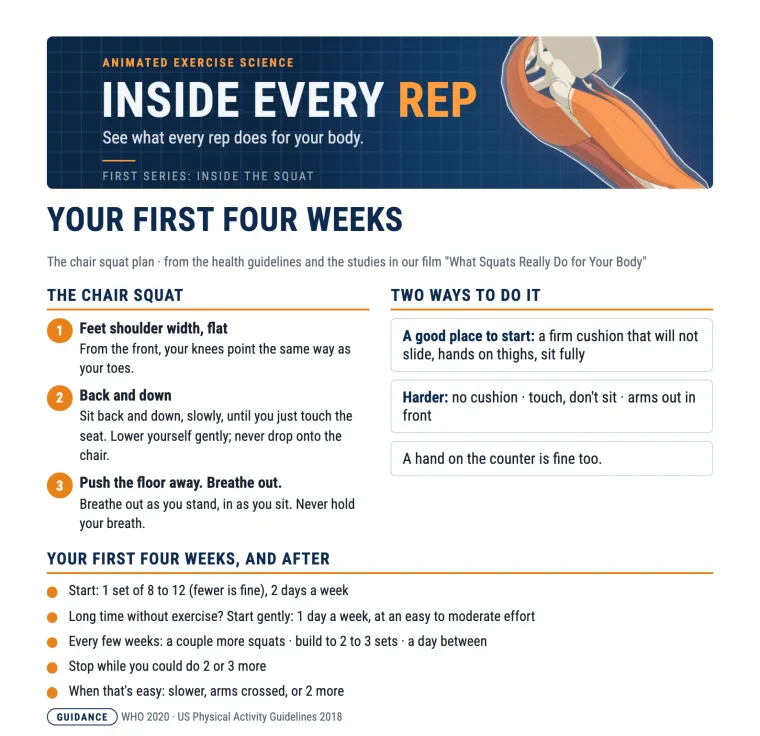
Soreness isn't proof it worked: in one trial, muscle grew just as well without it. Here's your first four weeks on one card. Screenshot it.

Your turn

Now tell us: which version did you do today, cushion and hands, no cushion, or arms crossed, and how many? Come back in four weeks and tell us again. Stand up slowly, with a hand near something solid. If you ever feel light-headed when you stand, tell your doctor.

Next up: your knees. The chair squat session is on screen now.

What's next

Watch on YouTube Subscribe

The top of the plan's first page: the chair squat in three steps, two ways to do it, and your first four weeks.

Two pages, to print in A4 or US Letter.

Free printable plan

Your first four weeks

The chair squat plan, from the health guidelines and the studies in our film “What Squats Really Do for Your Body”.

  • The chair squat in three steps, with a gentler way to start
  • How much to do at first, and how to build up
  • A tracker for your first four weeks
  • Staying safe: when to ask your doctor first, and when to stop

Free, with nothing to fill in. Privacy notice