Film · 10:39 · Coming soon
What Squats Really Do for Your Body
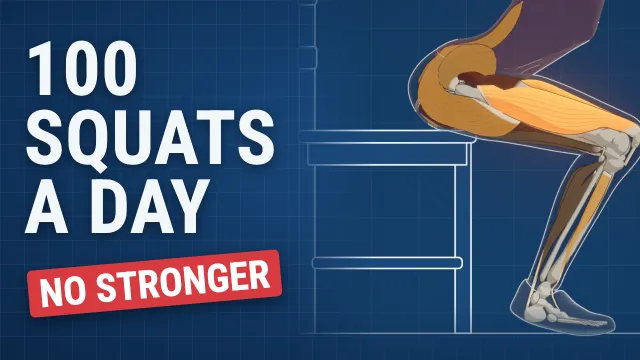
This film shows which muscles a squat works, what happens inside a muscle from today to ten weeks from now, and what the research says made the difference.
Watch the filmFollow-along · Inside the Squat · 8:15
Coming soon. Until then, find us on YouTube at @insideeveryrep.
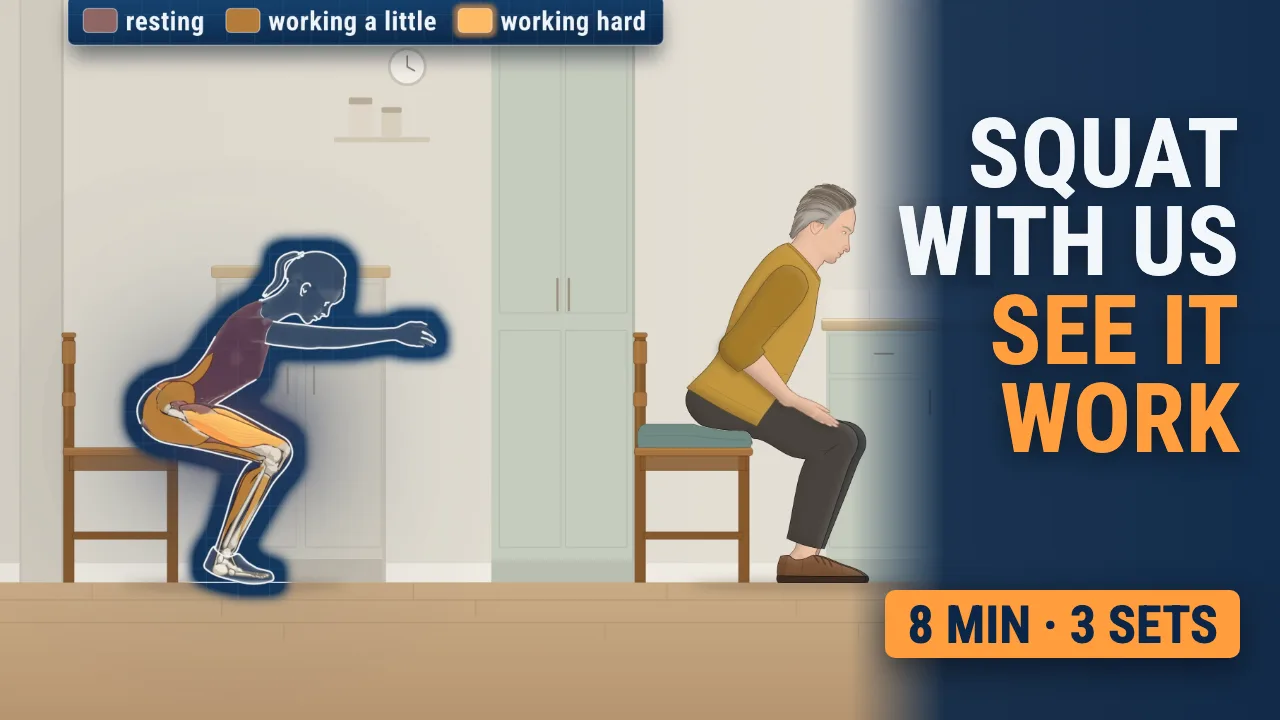
Three sets of up to ten chair squats in real time, with a rep counter, timed rests, and a look inside the working muscle. A gentler version is shown beside the standard one the whole way through. Use a solid chair with no wheels, one that will not slip, with its back against a wall. Keep something sturdy within reach. Clear the floor, and wear shoes that grip. Go at your own pace; stopping early is fine.
General fitness education, not medical advice.
Ask your own doctor first if you have: a heart condition · high blood pressure, even if controlled · diabetes · a pacemaker or defibrillator · a past stroke · a joint replacement · a bone, joint or muscle problem · a pregnancy · a fall in the past twelve months, or unsteadiness · any other medical condition.
Very high blood pressure that is not under control, or a heart condition that is not stable: not now. See your doctor.
If you haven't exercised in a long time, you don't need a doctor's visit just for that: start gently, one day a week at an easy to moderate effort, and build to two.
If anything hurts, stop. If you feel dizzy, light-headed or unwell, or your heart is racing, or you are unusually out of breath, sit down on your chair straight away, and stop for today. Speak to a doctor before you exercise again. And for chest pain, real trouble breathing, or fainting, call your emergency number. (999 UK · 911 US · 112 EU)
Stop and get medical advice straight away if your knee locks, gives way, swells badly or changes shape, clicks painfully, hurts badly, is red or hot and you feel feverish, or if you can't move it or put weight on it. Painless clicking is normal (NHS).
Follow your own surgeon's and physiotherapist's limits.
After a hip replacement the NHS advises a chair with arms, and not bending the hip past a right angle while it recovers.
After a knee replacement the NHS says: follow the hospital's advice and your physiotherapist's exercises, avoid twisting your knee or bending down as much as possible, and don't kneel on it until your doctor says you can.
Stand up slowly, with a hand near something solid. If you ever feel light-headed when you stand, tell your doctor.
Found a mistake, or a better study? Tell us in the comments under the film, or use our contact form.
General fitness education, not medical advice. If you have a heart condition or any other medical condition, if you're pregnant, or if you've had a fall in the past year or feel unsteady, check with your doctor first. The full list is in the description. If anything hurts, stop. If you feel dizzy, light-headed or unwell, or your heart is racing,
or you are unusually out of breath, sit down on your chair straight away, and stop for today. Speak to a doctor before you exercise again. And for chest pain, real trouble breathing, or fainting, call your emergency number.
Use a solid chair with no wheels, one that will not slip, with its back against a wall. Keep something sturdy within reach, clear the floor, and wear shoes that grip. Stand close, with the backs of your legs almost touching the seat. Three things to remember. Feet about shoulder width apart, knees pointing the same way as your toes.
Sit back and down. Lower yourself gently; never drop onto the chair. Push the floor away. Breathe out as you stand, in as you sit. Never hold your breath. A firm cushion that will not slide, hands on your thighs, and sitting right down before you stand is a good place to start, as our neighbour shows. A hand on the counter is always fine.
Go at your own pace; it is fine to fall behind the count, and fine to stop early. And if you are on that list, just watch for now.
Set one. Up to ten, nice and slow. Stop while you could still do two or three more. Down, slowly. Touch. And up. One.
Two.
Three.
Four.
Five. Halfway.
Breathe out as you rise. Six.
Seven.
Eight.
Nine.
And ten.
Sit down, gently. Pause the film if you need longer. New to this? One set is a good start. If that's enough for today, stop here.
In one study of forty-one adults squatting with no weight, the front of the thigh worked at up to about two-thirds of its full effort. The hamstrings barely worked. If ten felt easy, with more than three left, take one step harder for your next set. On the cushion? Take it away. Sitting right down? Just touch the seat. Already there and steady? Cross your arms.
After that, lower more slowly.
Stand up slowly, with a hand near something solid.
Set two. Up to ten more. Stop while you could still do two or three more.
Down, slowly. Touch. And up. One.
Two.
Three.
Four.
Five. Halfway.
Breathe out as you rise. Six.
Seven.
Eight.
Nine.
And ten.
Sit down, gently. Two sets is fine. If that is enough for today, stop here.
In one study of young adults training their arms, much of the early gain was the nervous system learning to switch the muscle on. In another, the fibres were clearly bigger by about week ten.
Stand up slowly, with a hand near something solid.
Last set. Up to ten, and stop while you could still do two or three more.
Down, slowly. Touch. And up. One.
Two.
Three.
Four.
Five. Halfway.
Breathe out as you rise. Six.
Seven.
Eight.
Nine.
And ten. That is the session. Sit down, gently.
Stand up slowly, with a hand near something solid. If you ever feel light-headed when you stand, tell your doctor.
One set, on two days a week, is enough to start. Then build up to this. Two or three sets, on two or more days a week, with a day between. When it gets easy, make it harder: slower, arms crossed, or two more.
Which version did you do today, and how many in your first set? Tell us, and come back in four weeks. The film on what happens inside your muscles is linked below.
Film · 10:39 · Coming soon
This film shows which muscles a squat works, what happens inside a muscle from today to ten weeks from now, and what the research says made the difference.
Watch the film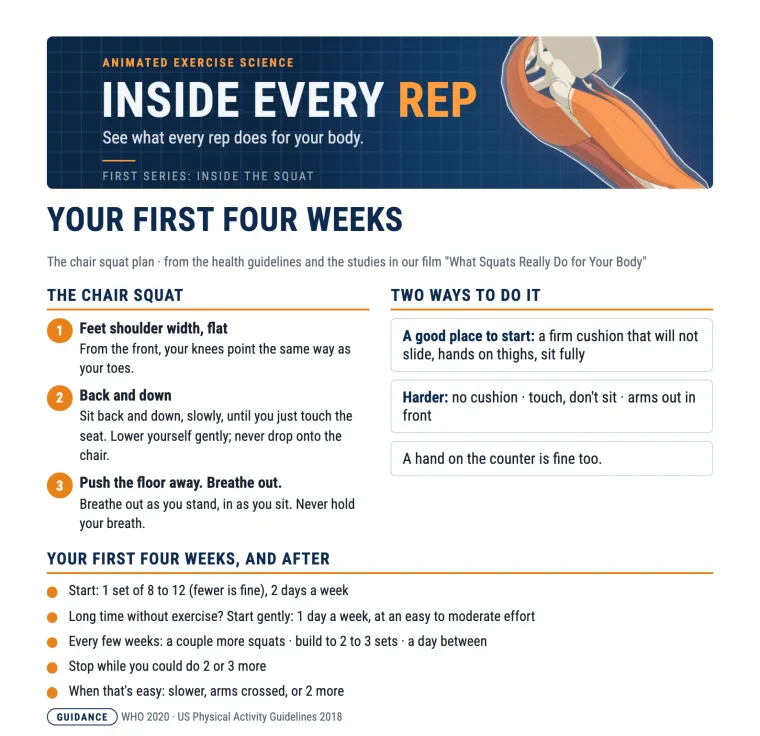
Two pages, to print in A4 or US Letter.
Free printable plan
The chair squat plan, from the health guidelines and the studies in our film “What Squats Really Do for Your Body”.
Free, with nothing to fill in. Privacy notice